PLASCOM
Advanced Functional Masterbatch Solutions for Film, Packaging and Polymer Processing
Hall 220115

Highlights
Masterbatch specialist since 2000. 11 extrusion lines, Korea 11,000 t/y + Vietnam 2,400 t/y. ISO 9001/14001; 2026 audit passed for a global chemical producer.
1. WHITE - TiO2 up to 80% on PE, PP, EP carriers; film, sheet, injection. High opacity at low let-down, dispersion verified by FPV.
2. BLACK - carbon black up to 50%, PO to EP. Dedicated kneader + CO-TSE line; deep jetness, stable dispersion in thin film, pipe, cable, fiber.
3. COLOR - matched to your resin, process and lighting, not to a chip alone. dE < 1.0 control limit.
4. FUNCTIONAL - flame retardant, antistatic, conductive; anti-fog, IR thermal, slip; PFAS-free processing aids replacing fluoropolymers; odour absorber for recycled PP, chemically adsorbing the acidic volatiles; mineral fillers.
5. ADVANCED - nanoclay for PE barrier, uniform nucleation, stiffness and lower FR loading; CNT grades by resin with designed surface resistivity; cellulose fiber 50-60% on PP, PE, biodegradable PLA (sampling).
We compound the difficult: high mineral loadings, flame retardants, heat-sensitive materials - product-specific screw design, pilot trials.
Booth 20115: bring your resin and process conditions.
PLASCOMは2000年創業のマスターバッチ専業メーカー。韓国(年11,000t)・ベトナム(年2,400t)の2拠点、押出11ラインで合計年13,400t。ISO 9001・14001取得、2026年グローバル化学メーカーの品質監査に合格。
1. 白色 — TiO₂最大80%。PE・PP・エンプラ系に対応。フィルム・シート・射出に。低添加でも高隠蔽、分散はフィルター圧力値で確認。
2. 黒色 — カーボンブラック最大50%、汎用~エンプラ。ニーダー+CO-TSE専用ラインで薄物フィルム・パイプ・ケーブル・繊維に。高黒度・分散安定。
3. カラー — 色見本合わせに留まらず、樹脂・加工条件・光源まで踏まえて調色。ΔE<1.0を管理基準。
4. 機能性 — 難燃・帯電防止・導電、防曇・保温・スリップ、フッ素樹脂代替のPFASフリー加工助剤、再生PP(r-PP)の酸性揮発分を化学吸着する消臭、無機フィラー。
5. 先端材料 — PEのバリア性・均一な核形成・剛性を高めるナノクレイ(難燃剤低減にも)、樹脂別に表面抵抗を設計したCNT、PP・PE・生分解性PLAキャリアに50~60%配合のセルロースファイバー(サンプル対応)。
無機高充填・難燃剤・熱に弱い素材にも、製品特性別のスクリュー構成とパイロット二軸で対応。小間20115。
PLASCOM自2000年创立以来专注母粒制造。韩国(年11,000吨)与越南(年2,400吨)两大基地、11条挤出线,合计年产13,400吨。已取得ISO 9001·14001认证,2026年通过全球化学企业品质审核。
1. 白色母粒 — TiO₂最高80%,适用PE·PP及工程塑料载体,用于薄膜·片材与注塑。低添加即具高遮盖力,分散性以滤压值确认。
2. 黑色母粒 — 炭黑最高50%,从通用聚烯烃到工程塑料。以密炼机+CO-TSE专用线生产,在薄膜·管材·电缆·纤维中实现高黑度与分散稳定。
3. 彩色母粒 — 不只对色卡,而是结合树脂·加工条件·光源条件调色,ΔE<1.0为管控基准。
4. 功能母粒 — 阻燃·抗静电·导电,防雾·保温·爽滑,替代含氟聚合物的无PFAS加工助剂,针对再生PP(r-PP)化学吸附酸性挥发物的除臭母粒,以及无机填充母粒。
5. 先进材料 — 提升PE阻隔性·均匀成核·刚性并可降低阻燃剂用量的纳米黏土、按树脂设计表面电阻的CNT、以PP·PE·可生物降解PLA为载体添加50~60%的纤维素纤维(样品阶段)。
无机高填充、阻燃剂、常规螺杆上易变色的热敏材料,均可通过按产品特性配置的螺杆组合与中试双螺杆的工艺再现来实现。欢迎莅临20115展位。
Exhibits / Service
 Add to My List
-
-
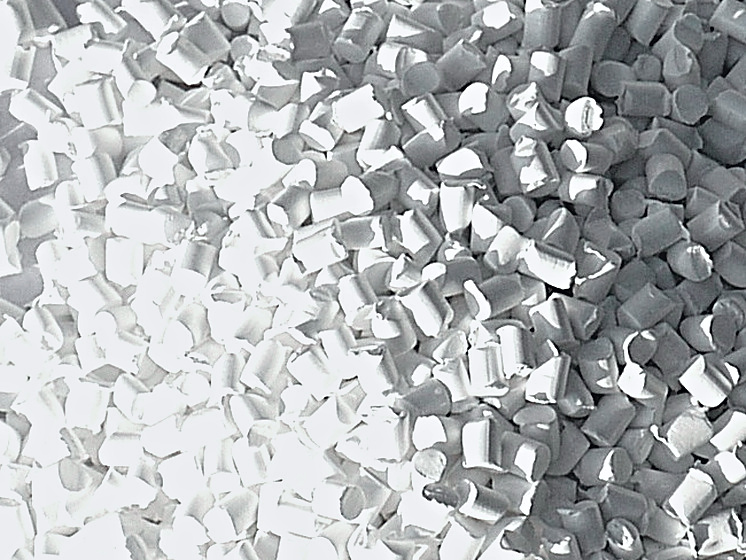
White masterbatch with rutile TiO2 at high loading and high dispersion - up to 80% on LDPE and LLDPE. A higher loading means a lower let-down ratio for the same opacity, which lowers cost per part. Carriers run from PE and PP to PS, ABS, PC, PET and nylon, and each grade is designed for its application: multilayer and silage film, flat and flexible packaging, heavy-duty sacks, OPP/CPP film and PP deco sheet, containers, vacuum forming and injection, appliance housings, opaque PC sheet, PET deco sheet and BOPET white film. The control points change with the application - whiteness and opacity first, then thermal stability, resistance to yellowing, retention of impact strength, and moisture management. For BOPET and other filter-sensitive lines we offer a low-FPV grade. Dispersion is verified by filter pressure value, colour by X-Rite spectrophotometer, and every lot passes a three-stage quality gate. We also adjust TiO2 content and carrier MI to your process, combine UV and antioxidant packages for outdoor use, and match whiteness to your own standard. Booth 20115 - bring your resin, processing conditions and target opacity.
-
-
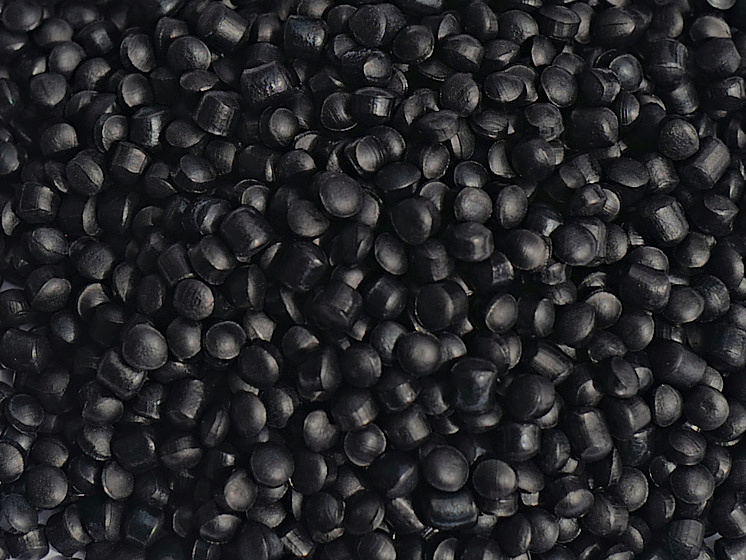
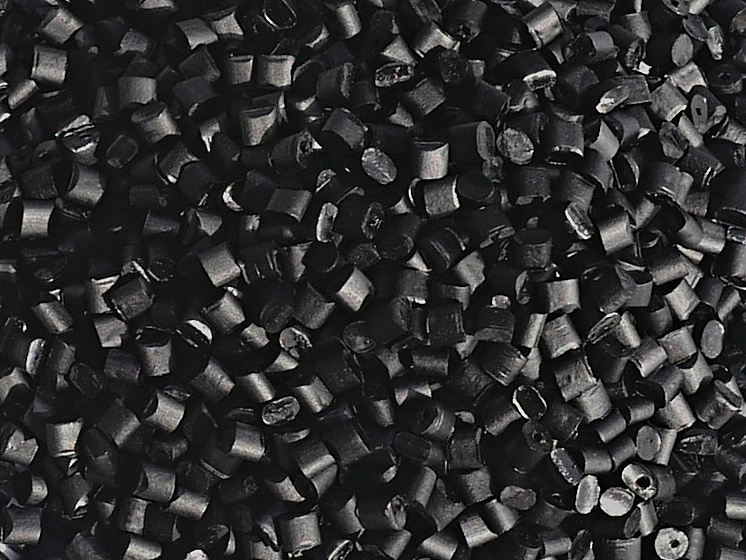
Black masterbatch for commodity resins, produced on a dedicated black line - two kneader + CO-TSE trains, 550 t/month - kept physically separate from our colour and white lines, so there is no cross-contamination risk. Carbon black loading reaches 50% on PE and 40% on PP and SAN. Grades are designed by application: PL9000M (PE, 40%, LD/HD film, extrusion, injection), PL9005 (LLDPE, 45%, high-dispersion and agricultural film), PL9002 (PE, 47%, PE/PP/PA extrusion), PL9003 and PL9004 (PE, 40-42%, economy grades for general extrusion), PL9103/9104 (SAN, 40%, ABS), PL9304 (PP, 35%, fibre and yarn). In thin-gauge film and fine-denier spinning a dispersion defect becomes a product defect, so dispersion is measured by filter pressure value rather than judged by eye, and every lot passes a three-stage quality gate. Besides carbon black we also run graphite and dye black. These are standard formulations; the final grade is fixed by sample evaluation once your carrier resin, processing conditions and target jetness are confirmed. Booth 20115.
-
-
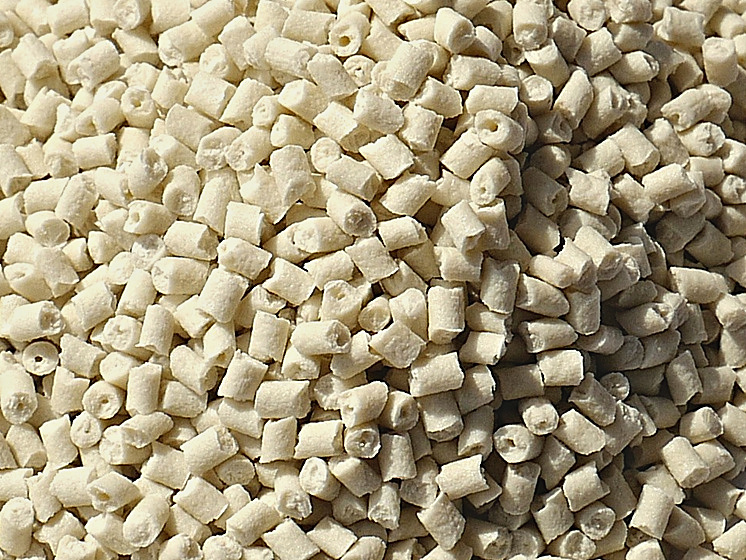
CNT (carbon nanotube) masterbatch that reaches target conductivity at a far lower loading than carbon black, so the base resin keeps its properties and appearance. Lineup by carrier resin: PLMNT15PP (PP, 15-20 wt%), PLMNT15PE (PE, 15-20 wt%), PLMNT10PS (PS, 10 wt%), PLMNT10PC (PC, 10 wt%) and PLMNT15PA (PA, 10-15 wt%); let down into your resin to reach the resistivity window needed. Surface resistivity design values at 1 wt% final CNT: 10^10-10^11 ohm on PP, 10^6-10^9 on PE, 10^3-10^5 on PS, below 10^2 on PC, 10^9-10^10 on PA. We also run hybrids with conductive carbon black: PL141CN (conductive CB + CNT) reaches 10^3 ohm, PL144AC (conductive CB only) 10^4-10^6 ohm - both PP, for EPP foam, injection and extrusion. With CNT, dispersion is the performance. Aggregates raise resistivity; excessive shear breaks the tubes and cuts the path. In a joint study with a university, optical microscopy of PP at 3 wt% final CNT showed an aggregate area ratio of 12.1% for simple compounding against 2.2% - about one fifth - for our design. Applications: electronic component trays and carriers, ESD packaging, conductive sheet and film, electrostatic-coating parts. Booth 20115.
-
-
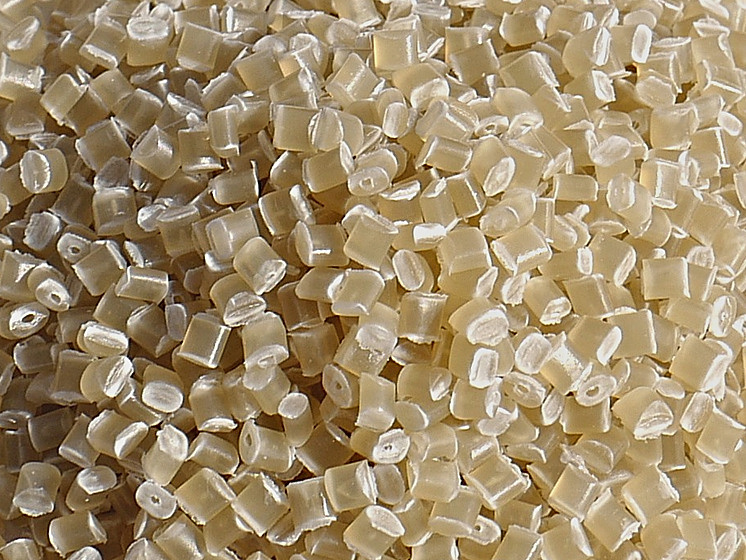
Masterbatch carrying plant-derived cellulose fibre at 50-60%, on three carriers: PP (MCF-7324), PE (MCF-7325) and biodegradable PLA (MCF-7326). It secures biomass content, reduces weight and raises stiffness at once, with let-down designed around the biomass content you must meet. Unlike mineral fillers it has a low specific gravity, so the part is no heavier at the same loading, and under 1% inorganic content means far less screw and die wear. Fibre grades run from a few microns to several hundred microns - cellulose fibre, not CNF - and length is chosen for reinforcement or for texture. Cellulose is heat-sensitive, carries moisture and has a low bulk density; all three work against high loading. We use a screw configuration reserved for heat-sensitive materials and gravimetric side feeders, so the target loading is reached without discolouration. Replacing fossil resin also lowers the part's carbon footprint. Typical uses: eco-conscious packaging, household goods, parts with a biomass requirement. These grades are at development and sampling stage; specifications may change with evaluation, and we propose a joint trial in your resin. Booth 20115.
-
-
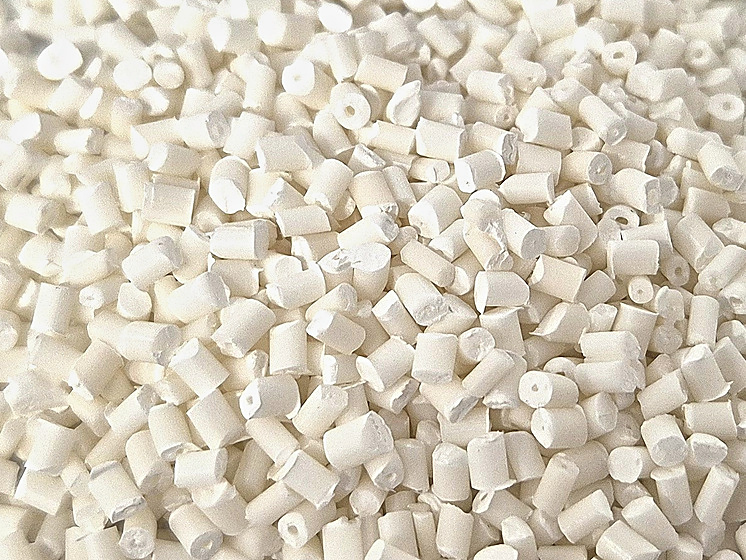
Masterbatch of layered silicate (montmorillonite) exfoliated and dispersed at the nanoscale. A platelet is about 1 nm thick and 300-1,000 nm across - aspect ratio 100-500, against 3-10 for talc or kaolin, so a small addition does the work. The same clay needs opposite targets: reinforcement and barrier need full exfoliation, while an FR synergist works better when the layered structure survives to build char. We design loading and dispersion grade by grade. PLNC15APP and PLNC15APE (PP/PE, 15 wt%, exfoliated, 10-20% let-down) raise stiffness and heat resistance, and act as an inorganic nucleating agent, lifting crystallisation temperature and shortening cooling time; in foaming they give uniform nuclei for finer, more even cells. PLNC50PP and PLNC50PE (50 wt%, intercalated, 10% let-down) form a dense char layer and suppress dripping; with ATH or MDH they open room to cut FR loading, recovering elongation and processability. PLNC30PA (PA, 30 wt%, exfoliated) lengthens the diffusion path against oxygen, moisture and hydrocarbons - polyamide and layered clay are a well-matched pair, and PA nanocomposite barrier is established in industry. Booth 20115.
-
-
SYNTHETIC ZEOLITE DEODORISING MASTERBATCH
- RAW MATERIALS & ADDITIVES COMPOUND MASTERBATCH
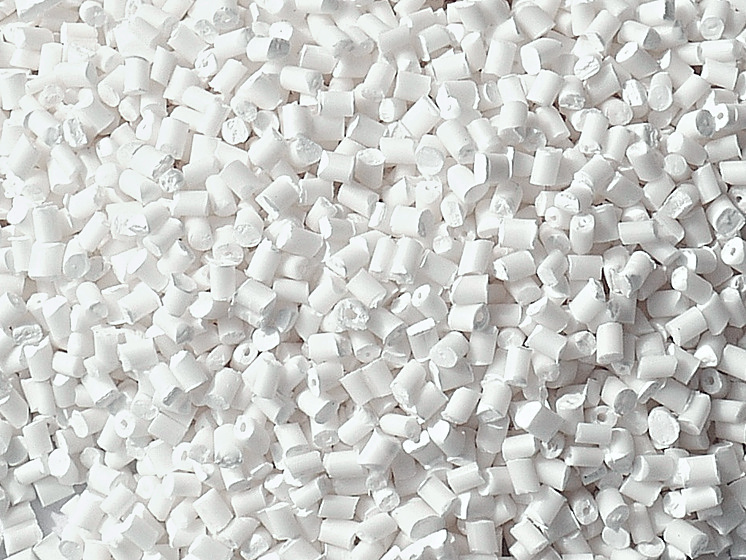
Deodorising masterbatch with synthetic zeolite dispersed at 60% (PLZE60PP, PP carrier, 1-3% let-down). Its pores take up the resin's own odour and the volatiles generated in processing, making the part more pleasant in use and cutting residual VOC. Being synthetic, not natural, it has uniform pore size and composition, so adsorption is managed to a design value. Compounding is continuous: gravimetric side feeders meter the powder into already-molten resin downstream, so loading is held to a set point rather than to batch weighing and lot-to-lot variation stays small. The zeolite also sees a short heat and shear history, so the pore structure survives the loading. At 1-3% it barely affects moulding or cost, and as an inorganic filler it raises stiffness. It suits parts that must meet both an odour and a mechanical requirement - automotive interiors, appliance housings, household goods, LFT compounds. Zeolite picks up moisture readily, so please reseal bags after opening. For the sour smell of recycled PP we offer PLOR40PP (40%, 2.5-7.5%, PP), an inorganic agent that chemically adsorbs acidic and basic gases and fixes them. Booth 20115.
-
-
INTUMESCENT PHOSPHORUS HALOGEN-FREE FLAME RETARDANT MASTERBATCH
- RAW MATERIALS & ADDITIVES COMPOUND MASTERBATCH
Halogen-free phosphorus-nitrogen intumescent flame retardant masterbatch. MFR-7100 carries 70% on a PP carrier. On heating, phosphoric acid builds a char layer while gas released at the same time expands it into a porous insulating foam that cuts off heat, oxygen and combustible gas - without the corrosive gases and smoke of halogenated systems. Low smoke and low gas corrosivity make it suitable where escape safety matters: building materials, rail and cable. ATH and MDH need loadings above 50-60% to work, and elongation and processability pay for it; an intumescent phosphorus system works at a much lower addition, so the resin keeps more of its properties. With a nanoclay that retains its layered structure (PLNC50PP, PLNC50PE), char formation and drip suppression improve further, opening room to cut FR loading another step. The rating is set together with wall thickness: tell us the resin, final thickness, target standard and colour requirement and we will propose formulation and let-down. We also offer halogenated MFR-7007 (70-80%) and MFR-7200 (50%, PE), a transparent flame retardant that does not cloud the film. Booth 20115.
Products / Service Category
- MASTERBATCH